Inside the European Auto Market: Why Paul Bennett Says Europe’s Carmakers Are in the Last Chance Saloon

Updated: 4 days ago
Paul Bennett, Managing Partner of Madox Square, joined Rosco on Amazing EV’s EV Marketplace, the Australian channel covering the used EV market, to talk about Europe’s carmakers. The episode, Inside the European Auto Market: The Shift You Need to Know, grew out of Paul’s article European Automotive Manufacturers Are the Authors of Their Own Demise. Asked where legacy manufacturers stand, Paul said he cannot see them getting back to the good old days.
A Market With 75 Brands and No Extra Customers
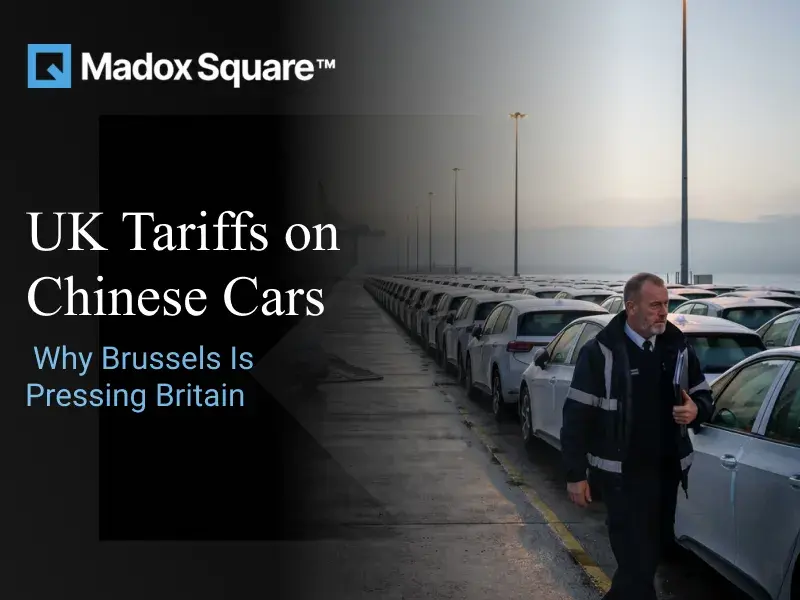
The UK has no volume carmaker of its own, which makes it the most open market in Europe. By Paul’s count, 45 passenger car brands were on sale before 2020 and 75 are on sale now, while registrations have stayed at about 2.2 million a year.
The clearest sign is Jaecoo, part of Chery. The Jaecoo 7 became the UK’s best-selling new car in March, with 10,064 registrations, from a brand that only began selling here in January 2025.
A 20-Year Plan in Plain Sight
Paul argued the surprise was misplaced. Chinese industrial policy set out in the early 2000s to make China a major automotive player through new energy vehicles, and he says exports are on course for 12 million vehicles this year. Half, he said, are battery electric or plug-in hybrid. The other half are petrol cars for markets that cannot yet absorb EVs. China sells every powertrain a market wants.
He also pointed to the joint-venture bargain. Volkswagen and others got access to a vast market by taking Chinese partners who held the controlling stake. Paul’s view is that Europe should have charged an equivalent price for access, and that its tariffs, up to 45% on Chinese-made EVs against a flat 10% in the UK, came too late because Chinese makers can absorb them.
The Fox Is in the Hen House
With European plants underused, Chinese groups are moving in. Nissan has a non-binding agreement to explore building Chery vehicles in Sunderland. Paul also cited a Ford and Geely deal, BYD’s plant in Hungary and a Leapmotor facility in Spain, and put it plainly: the fox is in the hen house now and is not going anywhere.
His explanation was speed. Chinese model cycles run at 18 months to two years against six or seven for legacy brands, and software-defined vehicles let China skip the combustion era.
Residuals Are the Acid Test
Why Chinese Brands Are Untested
Paul called residual value management the acid test. In China, finance is mostly instalment credit, but mature markets run on PCP, contract hire and operating lease. A new entrant’s priority is volume, and a low monthly payment can be flattered by a high residual. The lender takes the loss if values come back 10% lower, unless factory support covers it. We make the same point in a brand’s health is written in its used cars.
Rosco noted that insurers and lessors went in with almost no data. Paul agreed: forecasts rest on history, and with nothing to observe they were a finger in the air. Tesla’s price cuts a year or so ago then hit any lessor holding the older cars.
What Used EV Values Are Doing Now
Paul described used EV values rising just over 3% in June after a March and April spike he called an aberration. Solera cap hpi’s latest figures, published on 3 November, show some three-year-old EVs up as much as 28% in six months, with the Mini Electric rising from £9,905 to £12,710. Solera describes this as recovery from depressed positions, not a market running away.
Volkswagen, Japan and the Last Chance Saloon
Paul said Volkswagen is too big to fail, but it faces unions resisting cuts and a Lower Saxony stake of about 20%. He said CEO Oliver Blume wants to cut 100,000 more jobs and halve the model range, and that both are needed because the Chinese profits that once subsidised German costs are gone. Volkswagen has since confirmed its 2026 operating margin guidance would fall to no more than 1%, from a prior range of 4.0-5.5%.
On Japan, Paul said the big eight manufacturers have come together in principle on component sharing. He added that the UK’s zero emission vehicle mandate charges £12,000 to £15,000 for each car a maker misses, though credits can be bought from BYD or other EV makers. His closing view: legacy makers are in a last chance saloon and have to make it stick.
Talk to Paul Bennett
If you fund, lease or sell cars in a market where Chinese brands are scaling fast, how are your residuals holding up? Connect with Paul on LinkedIn or speak to us, and watch the full episode on Amazing EV.